


Indian Networks and Their Paths to Power

Chessy Ricca
Dr. Michael Francis
October 22, 2018
Indian powers within the American south focused primarily on furthering their private agendas. Long before Spaniards, French, or English colonists arrived in the New World, Indian communication paths were interconnected over enormous distances. Gold and supplies were a top priority to these Spanish colonists, but the Indian itinerary was always movement, harmony, war, trade and territorial control. Any information involving those current events was what gave the beholder power and domination over the lands.
Power, according to Alejandra Dubcovsky, rested on the communication transferred along the overland paths that connected Indian nations. Ease of movement was a necessity for intercultural exchanges amongst differing Indian groups. Indians traveled faster and smarter than their European counterparts. It was what Indians fought about; who could roam the routes and where their adversaries could travel (Dubcovsky 21). The specific information needed was what influenced the level of control. Those who carried news were highly sought after. Furthermore, the most common language used amid the various Indian communities dictated which group had the most control. Language was used as a demarcation tool and often times was strategic. In favor of the locals, Europeans missed out on important information. They were largely concerned with hearing the word ‘gold’ which led them away from details that would cost them their lives (Dubcovsky 31). Dubcovsky argues that gold played a leading role in the European exodus across the south. Other readings such as Eugene Lyon’s, “The Enterprise of Florida”, disagrees with this belief, proving that there was much more in the eyes of the Spaniards than just “oro”. Furthering the idea that Indians were always one step ahead of the Europeans is the evidence supporting this notion. Indians knew of Spanish diseases already and Soto found Indians practicing Christian based rituals but had no idea how that was possible. Indians knew the Spaniards were depending on them for information and exploited their needs, which allowed the Indians to manipulate European communications to their own advantage.
European powers’ urgent need for news depended on Indian interaction. However, Indians were hardly concerned with the settler’s whereabouts (Dubcovsky 44). This was proven, for example, in the names of Indian territories. ‘Timucua’ means enemy, a word given to a specific area on maps showing the best routes to avoid confrontation (Dubcovsky 45). The Catawba Deerskin Map shows relations between the Catawba Indians and the English, but only refers to the communication paths in favor of themselves (Dubcovksy 23). At no point in time do the numerous Indian nations put European concerns ahead of their own. Indians knew precisely what they were doing. To broaden their power over the south, they played the role of puppet-master, discretely dictating the alliances that the rival Europeans had to make. Urgency for information was so intense that both the Spanish and French became oblivious to the manipulation going on beneath their noses. Another form of Indian scheming was through the deployment of informers. An informer’s job was to twist information to benefit themselves, which awarded them control over the outcomes of potential conflicts.
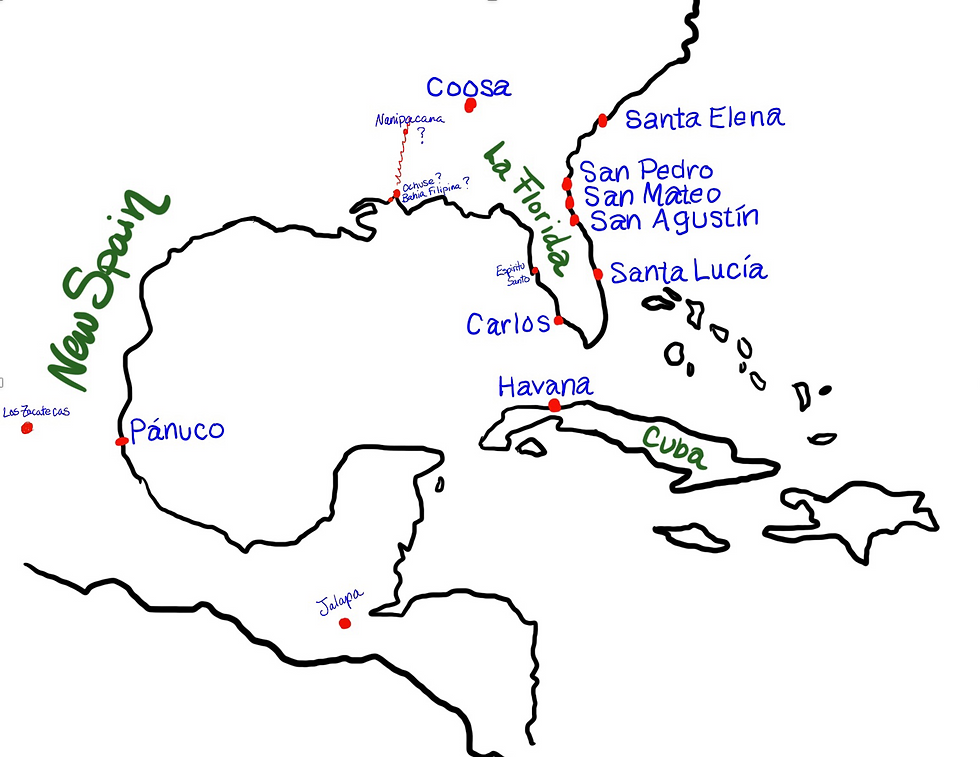
Territorial control was the ultimate goal for most Indian tribes. Standing in the way of that was the Spanish desire to dominate the south before other European powers seize control of their newly discovered land. Everything that gave the Spanish a glimpse of control was dependent upon the Indian paths and connections. First on the Spaniard’s list was inserting missions along the Indian communication networks. Dubcovsky argues that the Spanish motives were focused on the spread of Christianity. To an extent this may be true, but Spanish intent went much deeper that conversion. Indians saw the addition of missions moving closer to San Augustin as an opportunity to gain access to European goods (Dubcovsky 68).
Out of fear of being enslaved, the Indians remained one step ahead of the Spaniards, forcing an uprising that became known as the Timucua Revolt (Dubcovsky 91). The result of this rebellion was confusion for the Spanish Governor. It was a reminder that Spanish control wasn’t as palpable as previously thought. The information the Indians had regarding why the revolt transpired gave the Apalachee Indians an opportunity to yet again manipulate a European power. Governor Rebolledo was told what he wanted to hear, putting the power of information once again in Indian hands.
The south during this time was a land littered with power struggles. Indian nations tactically watched from a distance, waiting for opportunities to gain more control over what was once their territory. With slave raids and trade becoming a reality, possession of information was slowly losing its power. Indians struggled in trusting the English with valuable news because they learned it was used against them. In an effort to regain control, Indians fought back once again during the Yamasee War proving they never lost their power and even gained the support of runaway African slaves. The fall of the information networks connecting territories was to the advantage of the Indians because of the dependence put on them by Europeans for movement, travel, and the spread of news. “Besides reminding the English that they were neither in control of nor at the center of these connections, the Yamasee War exposed the scope, complexity, and limitation of Indian networks that otherwise remained hidden in plain sight” (Dubcovsky 169).
Information of the pathways and information passed through the pathways was the key to ultimate control in the American south. Those who knew that truth the best were the Indians who used their networks the most. English attacks and raids caused many alliances between the Spanish and Indians to fail, but the need for Indian networks was far too important for Spanish dominion (Dubcovsky 209). Priority number one for Spaniards was always making sure Indians were allies. English colonists in South Carolina tried their best to defeat the Catawba Confederacy, but because the impressive Indian networks, their attempts remained difficult and often bloody. Indian agendas continued to defeat Europeans in the fight for power and control. Through the withholding of pertinent information and the creation of false information, the Indians of the American south had power over all European colonists no matter the setbacks they may have faced in the drive to keep their territory.
Dubcovsky, Alejandra. Informed Power: Communication in the Early American South. Harvard
University Press, 2016.
Comments