


Very Illustrious Sire: Concerning What Happened in La Florida

Updated: Jan 5
The Tristan de Luna expedition is one of mystery, dishonesty, and defiance. It all began in 1554 when four ships were caught in a hurricane and wrecked off Padre Island, Texas. Paul Hoffman describes the tragedy as having a massive impact on how the Spaniards proceeded with future entradas. To prevent more Spaniards from dying by way of the native arrow, the new objective was to build more Spanish settlements for two reasons: protect those who were ship wrecked and also to pacify and convert the natives.
Hoffman takes on a religious argument stating that a treasury department member in new Spain named Santander used the fear of God to manipulate King Philip II into creating this future expedition. What exactly did Santander want with La Florida? He wanted to provide security for shipping, prevent vassals of another King from occupying the land they thought was theirs, he wanted to expand the colonial reach, convert souls, and finally, furnish an outlet for poor Spaniards. After reading Paul Hoffman’s chapter on Luna in A New Andalucía and a Way to the Orient, his argument sounded like Luna was used a chess piece in Philip II’s game. Religious conversion was the excuse used to attempt settlements connecting the Gulf with the Atlantic. In The Luna Papers, Santander is mentioned once at the end when he denied Luna’s request to increase his salary from 8,000 ducats to 12,000 ducats.
The Luna Papers is a collection of documents concerning what happened in La Florida. These files are some of the most confusing and devious letters between those in New Spain and La Florida. Tristan de Luna was given instructions as the governor to appoint officers the task of giving an account of what the settlers do to the Indians or to themselves. These officials were picked specifically because they were “the richest and most honorable towns people”. Luna’s other objective was to “settle and preach the Catholic faith to the natives”. The King’s orders were to settle specifically Santa Elena and no other town unless it was conducive to the service of God. He is to make a memoir of the provinces, indicating what should be placed under control of the King.
As with any expedition into New Spain and La Florida, the natives played a large role in keeping the settlers and soldiers alive. These papers, however, speak of the natives as if they were enslaved. Velasco wants Luna to remain friends with the natives in order to acquire more sustenance. However, Luna’s orders dictate that he is able to fire weapons at them to instill fear if they do not listen. For an expedition that is aimed at settling, pacifying the land and spreading Christianity, the orders seem very contradictory to their goals.
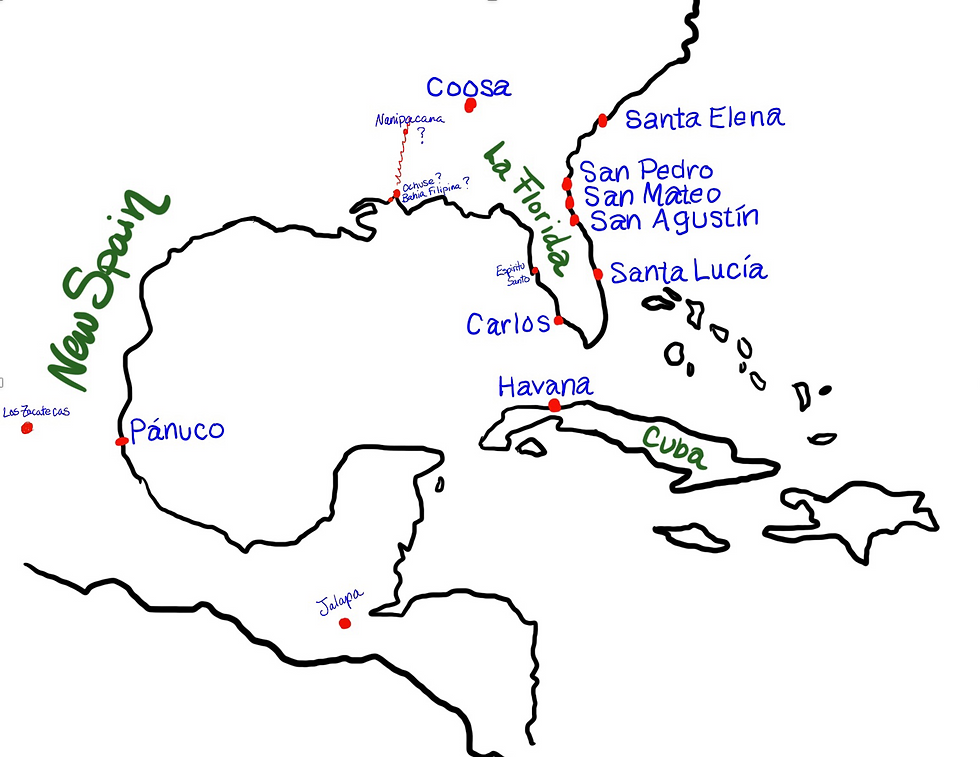
With the orders of the King and the whispers of Velasco in his ear, Luna decided to make a settlement in Coosa because it was the most fertile part of the land and it protects a route from the Rio de Espiritu Santo to Santa Elena. But we have heard of this land of Coosa before. Did the Soto expedition have an effect on this decision?
The Luna Papers tells a story of angry soldiers and captains petitioning to Velasco to plead with Luna over his decision to head inland to Coosa. When the actual documents are inspected, the reader will notice that Luna himself did not write the responses to the men’s petitions. It was Velasco. So whose idea was it truly to head inland and why did the soldiers and captains plead so desperately to not have to go? Discipline was a big issue. The Captains that were appointed did a very poor job at keeping the soldiers obedient to the King. When they received orders to head inland, almost immediately they were defiant. Petitions were sent to both Luna and Velasco but every time, Velasco was the one to respond. The soldier’s fear was that they would face certain death if they left. The men argued that there were extremely limited supplies, they were already starving, the horses were sick, the people were sick, and the land was baron. But was it? How did they survive from 1559-1561? Luna supplied them with food. They received bacon, biscuits, dried beef, and Maize. Oddly, the food was never picked up according to one of the documents. Why would these “starving” soldiers refuse food? Nanipacana most certainly had food there as well.
The bizarre observation about The Luna Papers, is that Luna himself does not respond directly, nor does he really make any of the decisions. When he did directly write, it was more of a threat exclaiming that any soldier who left will be deemed traitors. The Maestro de Campo, Cerón and Velasco took control of the Luna expedition via manipulation. It’s almost as if Cerón and Velasco intentionally wanted the settlers to hate Luna. At every petition that was sent to Luna, the response was always, “Luna said no, you must head inland.” To this, the Captains begin to argue that Luna isn’t of a sound mind and that he is ill. He is “incapable of governing and lacks the balance of judgement”. It certainly does sound like Luna is sending these men to certain death if they truly do not have food and they have to head inland to Coosa. How will they survive? But how did Soto survive? The soldiers even had a map that showed Soto’s route and how much food stuffs there was along the way. In another interesting twist, Luna asks the Maestro not to read the soldier’s petitions. Why? Luna even threatens to complain if the Maestro continues.
Here’s my struggle. Referring back to Soto’s expedition, he spoke of Coosa as being very fertile and a native metropolis. Coosa would make a great settlement because of its close proximity to Santa Elena. Again, when reading the papers, the facts are confusing. Who is telling the truth? What is the truth? The Captains and the soldiers are making this trip inland seem like death is creeping closer and closer to them each day. Like, any day they could die. But they don’t. The disobedience gets so out of control that some of the Captains are to lose their Indians, insinuating again that the Indians were more like slaves than good, converted Christians.
The big question is still unanswered. Why did “Luna” want the people in Nanipacana to go inland so desperately and why did their response consist of rude words, pure defiance, and talk of abandonment? I think the main players of the Luna Expedition are Cerón and Velasco. There is discussion of metals, silver, pearls, and even extracting mercury. Is there a business venture attempt in the making? Why the need to connect the Gulf to the Atlantic? There was certainly the King’s urgency to protect his land using ports and settlements. But in pg. 65, Velasco writes to Luna saying he needs to look for a route “in the matter of the plas because not much money has been made in the business”. What business? Note that plas is unidentifiable and some think it meant plata or mining.
We can’t forget about the friars. This expedition was supposed to be about them converting the natives. They have a drastically different take on the land. They describe to Luna the fertility of the land and how they are in debt to the Indians for their kind hearts. They are “happy with the hardships they have endured”. What kind of odd manipulation is going on there?! The friars also write that Coosa is fine, that no one has died and the Indians are nice.
A random citizen plead to Luna not to send them inland because the Maestro de Campo was evil. He is afraid the Maestro will punish more people since he already hung 2 soldiers. They want Luna to be present because those who are in charge will treat them better. But where was Luna? In The Luna Papers, his whereabouts are rarely mentioned. He did venture to Bahia Filipina. However, none of the correspondences were written in his words. The soldiers and captains were denied a meeting with Luna in person. That was one of the main demands they had: to meet with Luna directly to discuss going inland. It was denied. The papers read as if the Maestro is making the decisions for everyone. Even Luna had to write to the Maestro directly to advise him not to make any decisions without referring to Luna first.
It’s no surprise the expedition was labelled a failure, aside from the hurricane that destroyed the fleet. The amount of time wasted petitioning back and forth could have sprouted an excellent journey in summer months heading inland avoiding winter. That was the prime time to make the trip. Some say that Luna was mentally insane and ruined the expedition due to his inability to think reasonably. After reading The Luna Papers, I did not see any signs of mental instability from Luna. If anything, Cerón and Velasco are the ones who need to have their brains scanned. This book containing these translated documents was published to open the eyes of scholars into the world of La Florida just before the first permanent settlement on the continent was made just five years later.
Comments