


The Legend of Chicora: How It Inspired Exploration

Chessy Ricca
Dr. Michael Francis
September 19, 2018
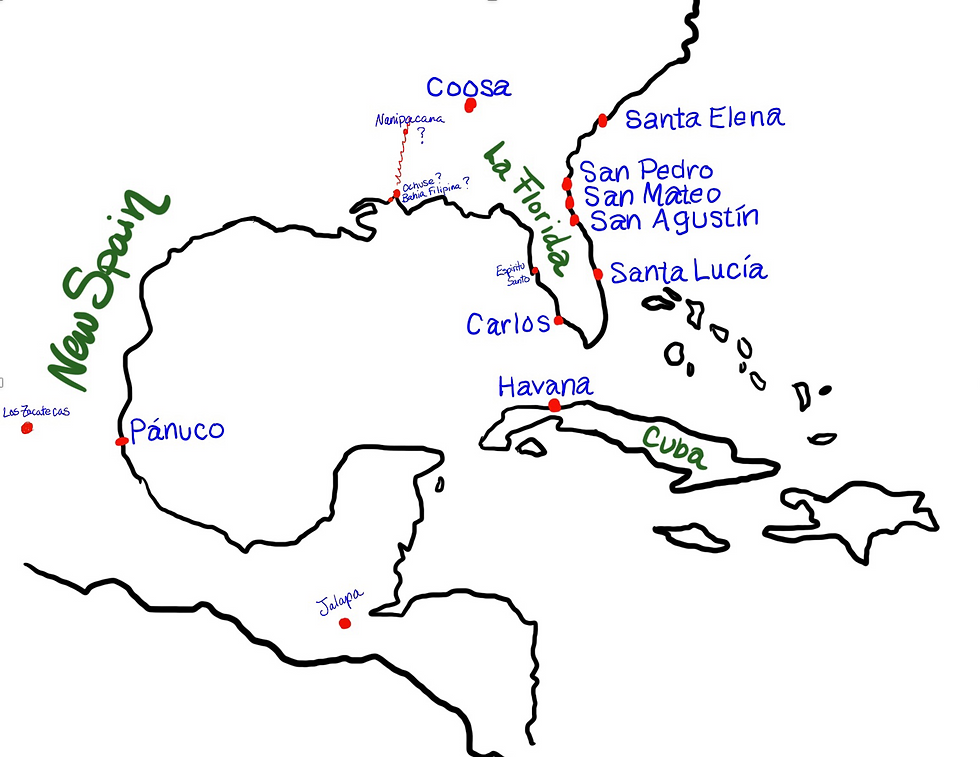
The Myths and Legends of the early 16th century were the foundation for Lucas Vazquez de Ayllon’s Spanish exploration of La Florida and the land’s ultimate colonization in 1565. In Paul E. Hoffman’s book, A New Andalucia and a Way to the Orient, he discusses how those Legends were instrumental in inspiring the multiple expeditions of the early 1500s.
The Chicora Legend lived by the writings of Peter Martyr, a man who never left Europe but wrote 4 Books called Decades based on discussions with the voyagers. Martyr used this tale to amuse the Duke of Milan possibly to gain a higher social status (Hoffman 85). He unknowingly proved Ayllon’s true intention was to receive licensing to explore and settle the new land (20). With slavery in mind, the adelantado was able to push toward his ultimate goal using myths such as giant Indians, terrestrial gems, and a new, more lush southern Spain-like world. Hoffman’s book describes the beginning of the expeditions to the New World and how the talk of these myths inspired the volunteers to pack up their lives in Spain and explore new territories to settle. Why else would they want to leave home? Being granted encomiendas in a New Andalucia rich with precious metals, fertile soils, wine and olive oil was just what the gullible Spanish citizens needed to hear to embark on the wooden galleons. And that was the plan for Ayllon; explore further this land discovery and gather the tall, muscular giant Indians for the slave trade.
Ayllon’s 1526 expedition to re-discover the land Pedro de Quejo discovered in 1521, the Jordan River and Chicora, failed on many levels. Supplies were low, no Indians were found, soil was poor, water was contaminated, some disease broke out, and his Chicoran translator, Francisco (“el Chicorano) abandoned the settlement. Out of 500-600 settlers, only about 150 returned to Spain (80). With all this devastation, why would the explorers want to keep going? Hoffman argues that those few survivors are what kept the legend alive for the next venture even after Ayllon’s death that same year (83), but the image he created of a new Andalucia slowly faded. Documentation was what kept the Legend alive for the following decades.
Martyr’s account of Ayllon’s 1521 expedition goes into great description about agriculture, gems and pearls (85). Furthermore, Diogo de Ribeiro’s master map showed in detail where Ayllon explored in America. To future explorers, the fact that inland North America was basically unknown was enough to keep them going back. Hernando de Soto’s trip to Peru proved that great wealth was possible in the sum of roughly 100,000 ducats, thus sparking a greater intrigue regarding the northern portion of the New World.
“…many believed that [North America] ought to contain other, even higher, Indian civilizations than those Ayllon had found or heard about. The long string of Spanish discoveries and conquests on the mainlands of Central and South America was creating a widely held belief that every unexplored part of the Americas might contain additional Mexicos or Perus (87).”
Hoffman verifies how these Legends kept inhibiting explorers to cross the Atlantic. The gold and silver brought back from Cuzco instigated further evaluation of the New Andalucia.
Even though the Spanish begin losing hope of ever finding the mystifying land of the Chicora, it’s Legend still survived. Francisco Lopez de Gomara’s book entitled Historia general de las Indias triggered a continuation of the search using the newly detailed accounts of Ayllon and Soto (125). The subsections of Gomara’s book, “Jordan River in the land of Chicora” and “customs of the Chicoranos” were paramount in the continuation of the Legend because now explorers (and civilians) had a location for the prosperous land (128). Hoffman contends that more books were being written about the ventures to the New World, keeping all of Europe’s imagination centered on money, myth, and movement towards the Americas. Even maps were becoming more available to the Spanish public. The Point of Santa Elena had grown to be synonymous with the Legend of Chicora (153).
Based off of Hoffman’s book, it can be concluded that the publications in literary form of the mid-1500’s let out all the once privately detailed information of the adventures West. The Land of Chicora was then technically able to be settled and colonized. Aside from wanting to find a faster way to the Orient for trading purposes and conversion of Indians to Christianity, the Spanish made it a top priority in 1559 to get to the Point for inhabitation before any other European power (153). Had it not been for the writings of Martyr, Gomara and Francisco Cervantes de Salazar, colonization of America would have been very different. Every explorer who entered La Florida after Ayllon, Verrrazzano, and Soto took notes from those books about where to go and why. Even men with abundant funding were entering the discipline of maritime navigation in hopes of fulfilling their dreams of discovering the Legend of Chicora (202).
The Chicora Legend laid the groundwork for the future of Florida because once settlement of St. Augustine took place, there was no longer any talk of it. Those Legends turned into an Enterprise brought on by Pedro Menendez de Aviles. It was now the truth that explorers were after. Did an “arm of the sea” leading to the Orient exist? And how can Menendez turn La Florida into an Enterprise by “sustaining the land at little cost and returning large revenue to the royal treasury” (236)? As the fables began to fade, so did the dreams of finding a new Andalucia. Hoffman laments the Legend’s culmination with the failings of John White, denoting the end of an era in 1590 (308). Luckily, however, the Legend helped shape the state we know today as Florida.
Hoffman, Paul E. A New Andalucia and a Way to the Orient: the American Southeast during the
Sixteenth Century. Louisiana State Univ. Press, 2004.
Fascinating how legends like Chicora drove real expeditions! Reminds me how tools shape exploration too — even a TI 84 Calculator maps modern discovery. Great read.